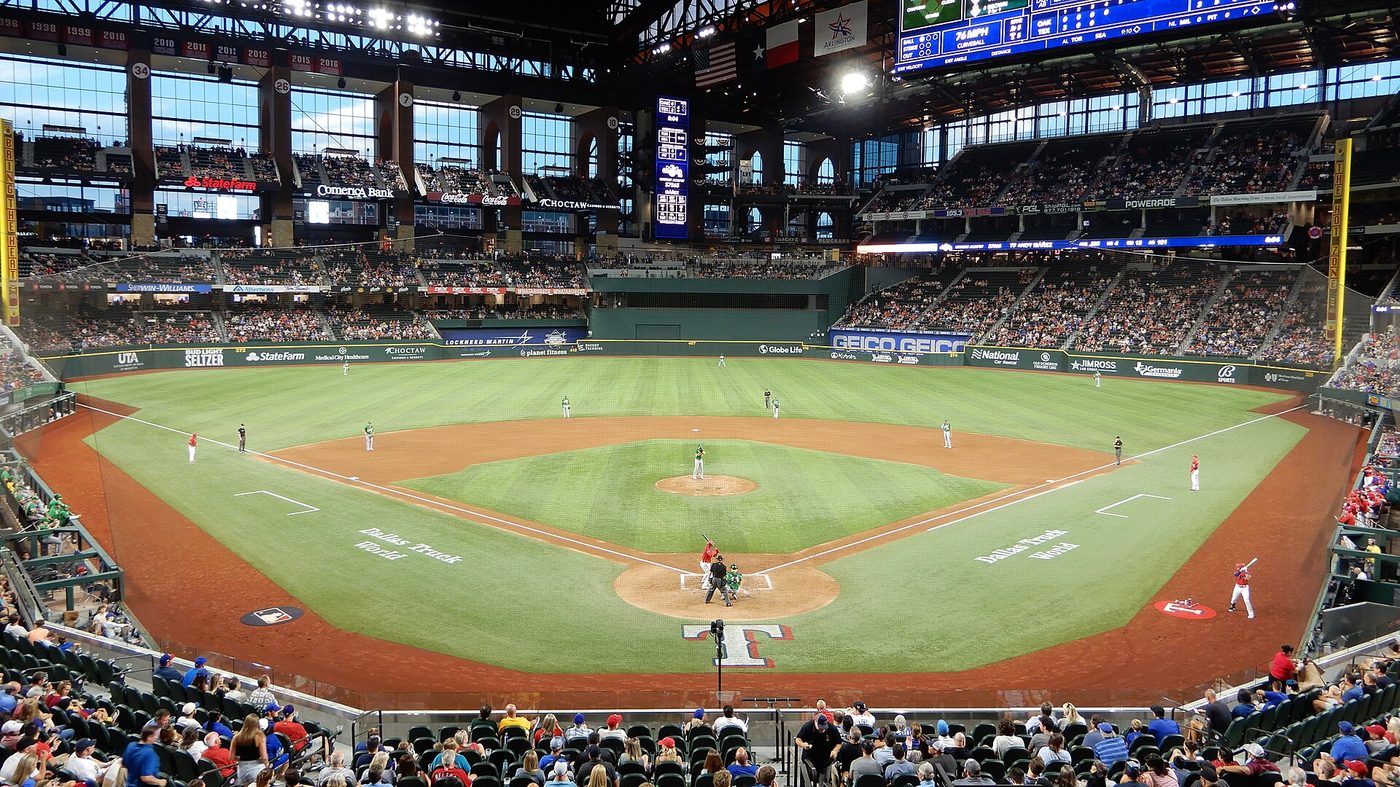
Four plays today and every one of them is a bet on a starting pitcher. Seven units to win against 10.59 units of risk, which puts the whole card at a 60.20 percent break even. Three of those seven units sit on one number that most American books do not even print: Texas at minus 1, a whole number run line that costs less than the Texas moneyline and refunds the stake if the Rangers win by exactly one.
Yesterday's seven play card went 3-4 and still made 1.61 units. That is the whole argument for sizing. The three winners were the two unit plays, the Royals team total under 3.5, the Cleveland run line and the Dodgers and Tigers under 7.5. The four losers were the one unit and half unit plays. Cleveland beat Kansas City 11-1, Los Angeles beat Detroit 6-1 for exactly seven combined runs, and the Royals never got past one. On the other side, Boston and the Yankees put up seventeen runs on an under 8, Seattle was shut out in Toronto, the White Sox and Twins managed six on an over 8.5, and the Mets lost to Houston. A losing record and a winning day.
ON THIS CARD
- The Card And The Math
- How The Units Are Counted
- Three Units On A Number Cheaper Than The Moneyline
- Two Starters Better Than The Teams Behind Them
- An 82 Win Club Against A Bullpen Game
- The Thinnest Play On The Card, And Why It Is Still Here
- What Can Beat This Card
- How The Last Card Graded
- Bottom Line
- Card FAQ
The Card And The Math
Four plays across four games out of the twelve on the board. Two start at 6:40 and 6:45 Eastern, the other two at 8:05 and 8:10. Eight games are being passed entirely, which is the highest pass rate on any card this week.
THE CARD
THE FOUR PLAYS
- Rangers -1 at -165, 3 units
- Astros ml -128, 1.5 units
- Red Sox/Mariners under 8 -120, 1 unit
- Rays ml -168, 1.5 units
WHAT EACH PRICE NEEDS
- -120: 54.55 percent
- -128: 56.14 percent
- -165: 62.26 percent
- -168: 62.69 percent
WHERE THE RISK SITS
- Rangers run line: 4.95 units
- Rays moneyline: 2.52 units
- Astros moneyline: 1.92 units
- Red Sox/Mariners under: 1.20 units
Almost half the day, 46.7 percent of the risk, is on one game in Arlington. That is deliberate and it is the part of this card worth arguing about.
How The Units Are Counted
Every number above is units to win, not units risked. Three units on the Rangers at -165 means 4.95 units of exposure to make three. One unit on the Fenway under at -120 means 1.20 of exposure to make one. Add the four together and the day risks 10.59 to make 7.00. If all four cash the day is plus seven. If all four miss the day is minus 10.59. Two winners out of four, if they are the two big ones, still finishes green.
Three Units On A Number Cheaper Than The Moneyline
Athletics at Rangers, Globe Life Field, 8:05 Eastern. Gage Jump against Jacob deGrom.
Start with the price, because the price is the reason this is the biggest play on the card. The Texas moneyline is -200. The Texas minus 1 run line is -165. Both bets need Texas to win. The run line asks for one extra thing, a win by two or more, and in exchange it returns the stake on a one run Texas win instead of taking it. To make three units on the moneyline you risk six. To make three units on minus 1 you risk 4.95. That is 1.05 units of exposure saved to give up the outcomes where Texas wins by exactly one, and a one run win is a push here, not a loss.
Now the baseball. Jacob deGrom is 9-9 with a 4.21 ERA, but the ERA is the least useful number on his line. He has struck out 159 in 130.1 innings against 37 walks, and opponents are hitting .234 with a 1.18 WHIP. That is a 4.3 strikeout to walk ratio against a club that walks its way into very little.
The club is the Athletics, and the Athletics are 53-84 with a run differential of minus 191. They have allowed 787 runs in 137 games, 5.74 a game, a team ERA of 5.43 and a team WHIP of 1.50. Every one of those is the worst figure among the eight teams on this card and it is not close. Gage Jump is 6-8 with a 4.69 ERA, a 1.46 WHIP and 42 walks in 88.1 innings. He misses bats, 97 strikeouts is real, but he also puts runners on at a rate that turns a two run deficit into a four run deficit in one inning.
DEGROM 2026
- 9-9, 4.21 ERA
- 1.18 WHIP, .234 against
- 159 K, 37 BB, 130.1 IP
GAGE JUMP 2026
- 6-8, 4.69 ERA
- 1.46 WHIP, .259 against
- 97 K, 42 BB, 88.1 IP
THE ATHLETICS STAFF
- 5.43 team ERA
- 1.50 team WHIP
- 787 runs allowed, 5.74 a game
Texas is 36-29 at home and 31-41 on the road, a 65 point difference in winning percentage between the two. This is a home start for the best pitcher on the card against the worst run prevention in the American League.
Two Starters Better Than The Teams Behind Them
Mariners at Red Sox, Fenway Park, 6:45 Eastern. George Kirby against Payton Tolle. One unit on the game staying under 8 at -120.
The honest version first. On raw season rates this total projects a shade over eight. Boston scores 4.45 a game and Seattle allows 4.39. Seattle scores 3.87 and Boston allows 3.83. Put those together and you land near 8.27, which is why the main market number is 7.5 rather than 8 and why the under 8 costs -120 instead of even money.
The case is that the season rate is not the right rate tonight, because both starters are better than the staffs they belong to. Payton Tolle is 8-6 with a 3.09 ERA, a 1.09 WHIP and 141 strikeouts in 125.1 innings, opponents hitting .218. Boston's team ERA is 3.57, the best mark on this card, and Tolle is comfortably better than that. George Kirby is 9-10 with a 4.02 ERA and a 1.33 WHIP, and while the WHIP is the weak spot, he walks 34 in 147.2 innings, so the traffic he allows is hit traffic rather than free traffic.
Behind Kirby is a Seattle offense with a .679 OPS, a .227 average and 530 runs, the worst of the eight teams here on all three. Taking 8 instead of 7.5 buys the eighth run as a push. That half run is worth about eighteen cents of price and on a whole number total in a park that plays to doubles rather than home runs, it is worth paying.
An 82 Win Club Against A Bullpen Game
Mets at Rays, Tropicana Field, 6:40 Eastern. Robert Stock against Ian Seymour. A unit and a half on Tampa Bay at -168.
Tampa Bay is 82-54 and 46-23 at home, the best home record among the eight clubs on this card. The Rays hit .260 as a team, the best average here, get on base at .329, the best here, and their staff runs a 3.77 ERA with a 1.15 team WHIP, the lowest on the board today. Ian Seymour is 9-5 with a 4.21 ERA and 128 strikeouts in 107 innings against 32 walks.
New York is 61-76 and sends Robert Stock, who is 0-3 with a 7.40 ERA, a 1.94 WHIP and thirteen walks in 20.2 innings. Opponents hit .307 against him. Twenty and two thirds innings is not a starter's workload, it is an opener's, and that is what this is. The Mets are asking a bullpen to cover most of nine innings against the best contact offense on the card in its own building.
-168 needs 62.69 percent. A club that wins 66.7 percent of its home games, against a 61-76 opponent throwing a 7.40 ERA arm, clears that.
The Thinnest Play On The Card, And Why It Is Still Here
White Sox at Astros, Daikin Park, 8:10 Eastern. Anthony Kay against Peter Lambert. A unit and a half on Houston at -128.
This is the play on the card with the weakest supporting case and it should be said plainly. Chicago is 72-64 with a run differential of plus 44. Houston is 69-68 with a run differential of minus 43. By record and by differential the White Sox are the better team this season and they are the underdog. Houston is also 33-35 at home, which is the only losing home record among the eight teams on this card.
What is left is the pitching matchup and the price. Peter Lambert is 8-7 with a 3.66 ERA, a 1.23 WHIP and opponents hitting .222, the second best opponent average of the eight starters going today. Anthony Kay is 9-6 with a 4.09 ERA, a 1.34 WHIP and 47 walks in 132 innings. Lambert has the better ERA, the better WHIP and the better opponent average. He also walks 51 in 128 innings, so this is not a clean edge, it is a small one.
-128 needs 56.14 percent. A home starter with a 3.66 ERA against a road club whose own starter sits at 4.09 is roughly a coin flip plus a little, and a little is all -128 asks for. It is a unit and a half rather than three for exactly that reason.
What Can Beat This Card
Three things.
Concentration in Arlington. 4.95 of the 10.59 units at risk are on one game and one pitcher. If deGrom gives up a three spot in the second, the largest position on the day is dead before the Rangers have batted twice, and the run line does not care that Texas might come back to win 6-5.
The favourite prices. Two of the four legs need better than 62 percent to break even. That is not a small ask, and the whole card needs 60.20 percent. Splitting 2-2 on this card, if the split is the wrong two, loses money.
The Fenway under is against the season rates. The combined offensive and defensive rates project 8.27 runs and the play needs seven or fewer. That is a starter driven bet and starter driven bets die in the fifth inning when the bullpens arrive early.
How The Last Card Graded
August 30 went 3-4 and made 1.61 units. Winners: Royals team total under 3.5 at -153 for two units, Cleveland minus 1 for two units, Dodgers and Tigers under 7.5 at -120 for two units. Losers: Red Sox and Yankees under 8 at -110, Mariners moneyline -139, White Sox and Twins over 8.5 at -130, Mets moneyline -120 for half a unit. The Cleveland run line went on the sheet without a price and is counted at the flat two units it was written for.
Cleveland beat Kansas City 11-1, which cashed both plays on that game at once. Los Angeles beat Detroit 6-1 for exactly seven runs on a 7.5 under. The Yankees put up sixteen on Boston and buried the under 8 by nine runs.
Bottom Line
Four plays, seven units to win, 10.59 at risk. The card is a bet on four starting pitchers being better than the four opposite them, and the largest single position is a run line taken specifically because it prices cheaper than the moneyline on the same outcome. If the day only gets one right, the one to want is Arlington.
Card FAQ
What is Rangers minus 1 and why not minus 1.5?
Minus 1 is a whole number run line. Texas by two or more wins it, Texas by exactly one refunds the stake, a Texas loss loses it. The mainstream minus 1.5 is priced near +106 and turns every one run Texas win into a loser. Minus 1 at -165 keeps those games alive as pushes and still costs less than the -200 moneyline.
Why is the Rangers play three units when Texas is 67-70?
Because the bet is the matchup, not the season. Texas is 36-29 at home, deGrom has 159 strikeouts against 37 walks, and the opponent has allowed 787 runs in 137 games with a 5.43 team ERA. The record on the marquee is the least relevant number in the game.
Why an under 8 when the season rates say 8.27?
Because both starters beat their own staffs. Payton Tolle carries a 3.09 ERA and a 1.09 WHIP for a team at 3.57, and Seattle brings a .679 OPS offense, the worst on this card. Taking 8 rather than the market 7.5 buys the eighth run as a push for about eighteen cents.
Why is Houston the smallest priced favourite on the card?
Because it is the thinnest edge. Chicago is the better team by record and by run differential and Houston is 33-35 at home. The case is Peter Lambert at a 3.66 ERA and a .222 opponent average against Anthony Kay at 4.09, and that supports a unit and a half at -128, not three units.
How much does the whole card need to win to break even?
60.20 percent, from 10.59 units of risk against seven units of profit. Leg by leg it is 54.55 percent at -120, 56.14 at -128, 62.26 at -165 and 62.69 at -168.
Were all four picks posted before first pitch?
Yes. All four were logged on the graded record before the 6:40 Eastern start in Tampa, which is the earliest game on the card.
How did the last card grade?
August 30 went 3-4 and made 1.61 units. The three two unit plays all cashed and the four smaller plays all missed, which is the whole reason a card can lose the record and win the money.