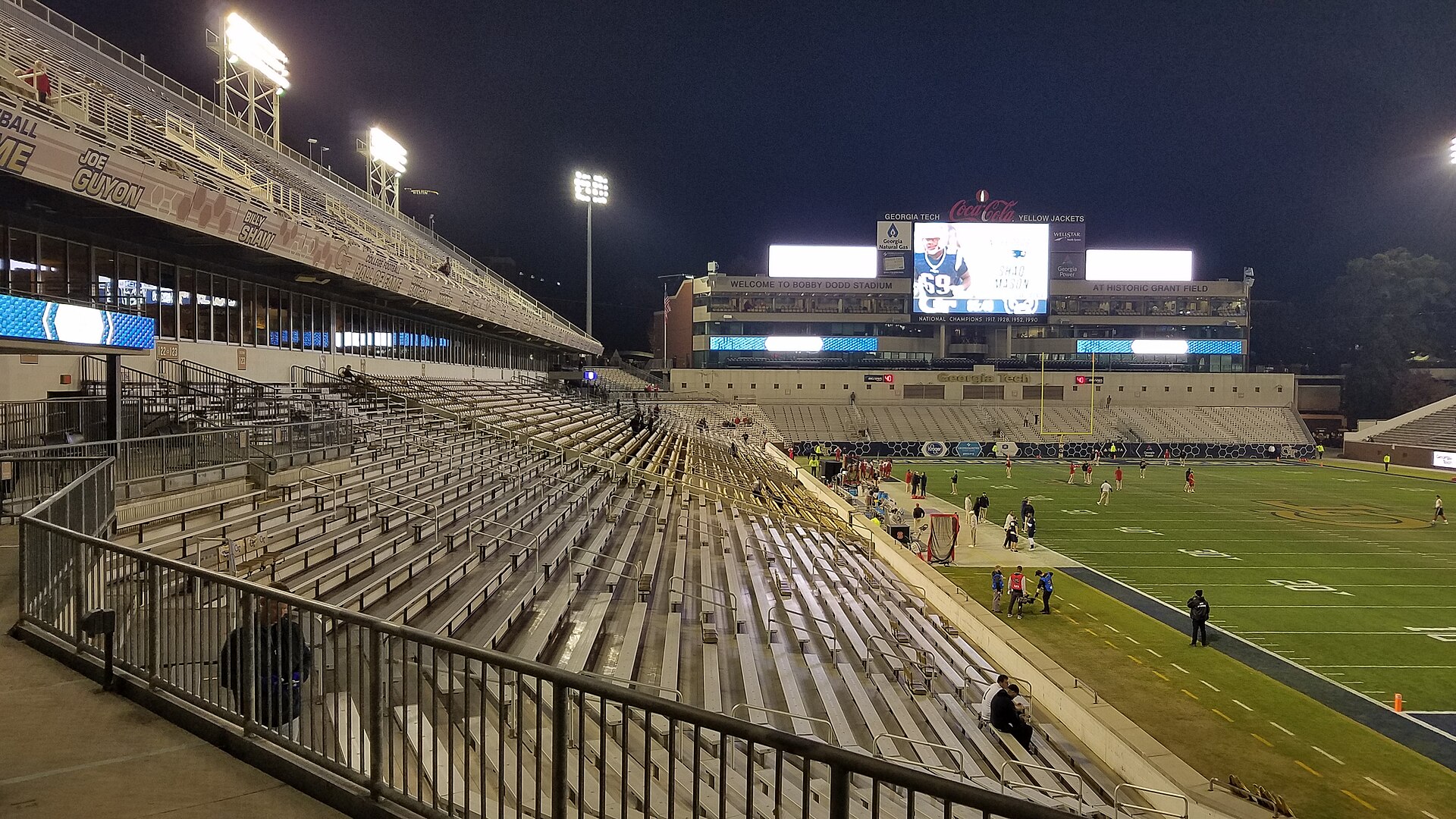
College football opens the card tonight and it takes the biggest number on it. Georgia Tech hosts Colorado at 8:00 pm eastern and the play is the moneyline at -240 for five units to win. The spread is 6.5. The moneyline is the same read with a different failure condition, and the failure condition is the point: Colorado has to win the football game to beat this ticket, not cover a touchdown in a loss.
Three plays, 8 units to win against 16.5 units of risk, which puts the card at a 67.35 percent break even. That is a high number and it is high for one reason, which is that Georgia Tech is 72.7 percent of the exposure by itself. Yesterday's seven play card went 3-4 for minus 5.15 units, and the three unit Rangers moneyline losing 9-2 to the worst run prevention team in baseball is most of that hole.
ON THIS CARD
The Card And The Math
| Play | Price | To Win | Risk |
|---|---|---|---|
| Georgia Tech moneyline | -240 | 5.0 | 12.00 |
| Seattle Mariners minus 1 | -160 | 2.0 | 3.20 |
| Tampa Bay Rays moneyline | -130 | 1.0 | 1.30 |
| Card | 8.00 | 16.50 |
Every price on the card is a minus number, so every unit figure is the amount being won and not the amount being put up. Eight units of profit costs 16.5 units of risk, and the gap between those two columns is the entire reason the risk column exists on this table at all.
How The Units Are Counted
Georgia Tech at -240 needs 70.59 percent to break even on its own, and five units to win costs 12 units to lay. That is 72.7 percent of the day's risk on one football game. There is no way to describe this card except as a Georgia Tech card with two baseball tickets attached.
The Mariners run line at -160 needs 61.54 percent of the outcomes that are not pushes. The Rays at -130 need 56.52 percent. The whole card, 16.5 divided by 24.5, is 67.35 percent. On three tickets weighted this way the honest version is simpler than the arithmetic: win Georgia Tech and the day is fine, lose it and the two baseball plays cannot fix it.
Five Units On Georgia Tech
Georgia Tech moneyline, -240, 5 units. Both teams are 0-0 and there is no 2026 form to read, so this is a bet on what the two rosters did over a full season last year and on the fact that one of them travels badly.
Georgia Tech finished 9-3 and 5-1 at home. At Bobby Dodd they scored 38.7 points a game and allowed 22.5. The offense averaged 33.1 points overall on 203 rushing yards a game at 5.6 a carry with 30 rushing touchdowns, and the quarterback play behind it completed 71.5 percent for a 156.1 rating with six interceptions in twelve games. That is a run first team that does not give the ball away, and a run first team that does not give the ball away is the profile that beats an opponent it is better than.
Colorado finished 3-9, and 0-5 away from home. On the road the Buffaloes scored 16.8 points a game and allowed 35.4. Over the full season they averaged 20.9 points, ran for 125.6 yards a game at 3.5 a carry, completed 58.7 percent with eleven interceptions, and went 1-8 in conference play. Their defense produced thirteen sacks all year against Georgia Tech's twenty six.
Put the two road profiles next to each other and the moneyline is the cleaner instrument than the 6.5. A team that scored 16.8 a game in five road losses does not usually keep a 38.7 point home team inside a touchdown, but the way it happens when it happens is a late garbage touchdown, and a late garbage touchdown costs a spread bettor everything and costs a moneyline bettor nothing.
Why The Moneyline And Not The 6.5
Six and a half at roughly even money asks Georgia Tech to win by a touchdown. The moneyline at -240 asks Georgia Tech to win. Those are not the same question and the gap between them is where opening week games get decided.
Season openers are sloppy. Teams with new coordinators and new quarterbacks start slowly, sit on a two score lead in the fourth quarter and let a beaten opponent walk into a meaningless touchdown against a backup secondary. A Georgia Tech win by three or by six is a full loss on the spread and a full win on the moneyline. Paying -240 instead of -110 is buying that band of outcomes, and against an opponent that lost its five road games by an average of 18.6 points, that band is worth more than the extra juice.
The break even on the moneyline is 70.59 percent. Georgia Tech was 9-3 last season and 5-1 at home. Colorado was 3-9 and 0-5 away. If those two profiles are anywhere near what the rosters still are, the win probability is comfortably north of the price. That is the whole argument, and it is an argument about the win column rather than the scoreboard.
A Whole Number In Seattle
Seattle Mariners minus 1, -160, 2 units. The full game moneyline is -216 and the standard run line at -1.5 pays plus money, which is the market telling you a one run Seattle win is a live outcome. Minus 1 is the whole number in between. Seattle has to win by two or more, a win by exactly one refunds the stake, and the ticket costs -160 rather than -216.
The reason to lay anything at all is the visiting team. The Athletics have allowed 805 runs in 140 games, 5.75 a game, the worst run prevention in baseball, on a 5.45 team ERA and a 1.50 WHIP. Jack Perkins starts with a 6.42 ERA, a 1.49 WHIP and 1.70 home runs per nine across twelve starts and a 3-10 record. He strikes people out, 10.29 per nine, and he also gets hit hard enough that the strikeouts have not saved him once all season.
Seattle has won 45 of its 66 wins by two or more runs, so 68 percent of Mariners wins clear this number and most of the rest push rather than lose. The last three meetings between these two went 9-2, 4-1 and 9-1 to Seattle. The argument against is real and it is Seattle's own lineup, which scores 3.96 a game on a .229 team average, and a starter in Kade Anderson who has ten major league innings to his name. That is why this is two units and not five.
One Unit On McClanahan
Tampa Bay Rays moneyline, -130, 1 unit. The Rays are 83-56, the best record on the card, and Shane McClanahan takes the ball with a 3.19 ERA, a 1.11 WHIP, a .206 opponent average and 0.72 home runs per nine across 113 innings. Tampa Bay pitches to a 3.78 team ERA, the lowest of the four clubs playing tonight.
The reason it is one unit and not three is Cal Quantrill, who has a 3.01 ERA and a 1.10 WHIP over eleven starts, and the fact that Texas is 38-30 at home while Tampa Bay is 36-31 on the road. That is a fair fight between two good starters, and -130 is a fair fight price. A small ticket on the better team is the right size for it.
What Can Beat This Card
The obvious one is the concentration. Twelve of the sixteen and a half units at risk are on a season opener between two teams with no 2026 film, which is the least predictable kind of football game there is. Week one produces upsets every year for exactly this reason, and a 3-9 team with a new depth chart is not the same team that went 0-5 on the road.
The second is the price itself. Laying -240 means a 70.59 percent break even, and there is no version of a college football game where that is a comfortable number. One turnover returned for a score, one special teams disaster, and a 3-9 team hangs around long enough to win a game it has no business winning.
The third is that the Mariners run line asks a 66-74 team with the lowest batting average in the American League to win a game by two runs behind a starter with ten innings of experience. The Athletics bullpen is the reason the ticket exists, but bad bullpens still hold leads sometimes and Seattle still gets shut out sometimes.
How The Last Card Graded
September 2 finished 3-4 for minus 5.15 units. The Brewers moneyline cashed 9-5 over the Cubs, the Red Sox team total under 4.5 cashed on a three run Boston night, and the Guardians team total under 3.5 cashed on a shutout, Toronto 11 Cleveland 0. The losses were heavier: the three unit Rangers moneyline went down 9-2 to the Athletics, the Cubs under 3.5 died on five runs in the same game the Brewers moneyline won, the Rays minus 1 lost 10-4 to the Mets, and the White Sox and Astros over 8.5 finished 2-0.
Bottom Line
Three plays, 8 units to win, 16.5 at risk, break even at 67.35 percent, and 72.7 percent of that risk on one football game in Atlanta. The case is Colorado's 0-5 road record at 16.8 points a game against a Georgia Tech team that went 5-1 at home at 38.7, bought on the moneyline so a cosmetic late score does not matter. The two baseball tickets are sized as what they are, a discounted run line against the worst run prevention staff in the sport and a small play on the best starter pitching tonight.
Every one of these three is posted publicly with the price and the unit size before kickoff and first pitch, and graded on a verified record afterwards. The full record is here, win or lose.
Card FAQ
What are the BetLegend plays today?
Three plays for 8 units to win. Georgia Tech moneyline -240 for 5 units, Seattle Mariners minus 1 at -160 for 2 units, and the Tampa Bay Rays moneyline -130 for 1 unit.
How are the units counted on this card?
Every price is a minus number, so every unit figure is the amount being won rather than the amount being put up. Georgia Tech at -240 costs 12 units of risk to win 5. The card lays 16.5 units to win 8.
What does this card need to hit to break even?
67.35 percent, which is 16.5 divided by 24.5. That is a high number because one play carries 72.7 percent of the risk. Georgia Tech alone decides whether this card is green.
Why Georgia Tech on the moneyline instead of the spread?
The spread is 6.5 and the moneyline is -240. Taking the moneyline means Colorado has to win the game outright to beat the ticket, not just stay within a touchdown. Georgia Tech went 5-1 at home last season averaging 38.7 points. Colorado went 0-5 on the road averaging 16.8 and allowing 35.4.
What happens if Georgia Tech wins by less than a touchdown?
The moneyline cashes and the spread does not. That is the entire reason this ticket is the moneyline. Colorado lost its five road games last season by an average of 18.6 points, but a season opener that ends 27-24 pays a moneyline bettor in full.
What is a minus 1 run line?
A whole number spread in baseball. Seattle has to win by two or more runs for it to cash and a win by exactly one refunds the stake. It costs -160 instead of the -216 full game moneyline, and the push is the reason for the discount.
Why the Mariners minus 1 against the Athletics?
The Athletics have allowed 805 runs in 140 games, 5.75 a game, the worst run prevention in baseball, on a 5.45 team ERA. Jack Perkins carries a 6.42 ERA, a 1.49 WHIP and 1.70 home runs per nine. Seattle has won 45 of its 66 wins by two or more runs and took the last three meetings 9-2, 4-1 and 9-1.
Why only one unit on the Rays?
Because it is a road favorite and Cal Quantrill has a 3.01 ERA over eleven starts. Shane McClanahan is the better pitcher at a 3.19 ERA and a .206 opponent average, and Tampa Bay is 83-56, but -130 on the road is a one unit price rather than a headline play.
How did the last card grade?
September 2 went 3-4 for minus 5.15 units. The Brewers moneyline, the Red Sox team total under and the Guardians team total under all cashed. The three unit Rangers moneyline lost 9-2, the Cubs under lost, the Rays minus 1 lost 10-4 and the White Sox and Astros over died on a 2-0 final.