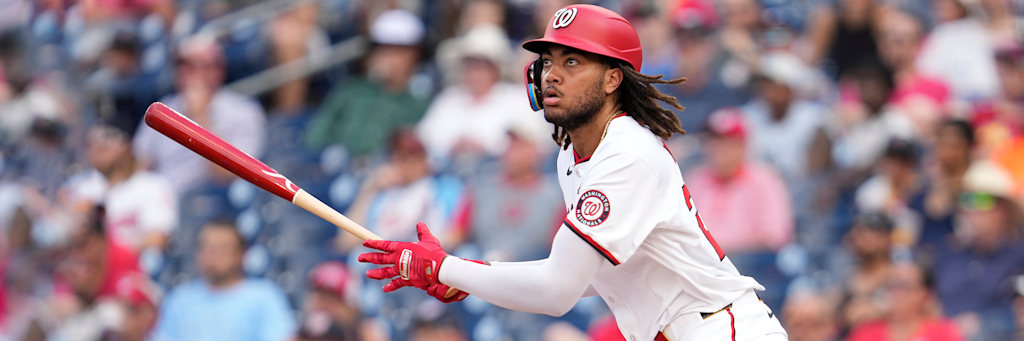
Saturday afternoon at loanDepot Park with the Washington Nationals in the visitors' dugout and the closing market posting Washington on the moneyline at +139 against the Miami Marlins at -156. The Marlins walk into the home spot carrying the headline ERA gap on the headline pitcher matchup card — Janson Junk's 2.82 ERA against Zack Littell's 7.24 — and the recreational room has read the matchup the way it usually reads any pitcher-gap card with a struggling rotation arm on the visiting side: chalk up the home favorite, lock in the headline ERA story, move on. The shape underneath the price is a different read. James Wood and the Washington top-of-order have produced a lineup-versus-RHP wOBA across the rolling 2026 sample that compresses Junk's contact-management profile into a higher-baseline run-distribution shape than the surface ERA implies, the loanDepot Park indoor run-environment trends neutral-to-slightly-hitter-friendly inside the dome's controlled-air pattern, and the Littell start on the visiting bump is a strike-throwing right-handed shape that holds the Marlins' lineup-versus-RHP wOBA against a workable inning-by-inning game-state. The closing +139 price implied 41.8 percent sits 4 to 7 points below the model's projected Washington win probability in the 46 to 49 percent zone. The pick is Washington Nationals moneyline at +139 for 2.5 units.
Pick of the Day
James Wood And The Washington Top-Of-Order Vs Junk's Contact-Management Profile
The first thing the closing line is paying for is the surface-versus-shape gap on the Janson Junk profile. Junk's 2026 stat line of 2-3 with a 2.82 ERA across his early-season turn through the league is the headline number. The structural read inside that headline is the contact-management profile rather than a strikeout-driven outing pattern. Junk's strikeout rate sits below the league baseline, his walk rate sits inside the average band, and his run-prevention has leaned on contact-quality outcomes that hover above the league's batted-ball randomness range. The profile produces a wide variance window inning-to-inning. Against a contact-quality lineup that drives the ball into the middle of the field at above-baseline rates, the projected runs distribution shifts upward beyond what the surface ERA implies.
James Wood in the heart of the Washington order has produced a 2026 batting line near .247 with double-digit home run output across the early-season sample, and his pull-side power against right-handed contact-management starters has compressed his career baseline above league-average for that profile. CJ Abrams at the leadoff slot brings the speed-and-contact left-handed bat that converts contact-quality outcomes into base-running pressure, and his career split versus right-handers with below-baseline strikeout rates has produced an above-baseline on-base percentage. The expected at-bat distribution across the Washington top-five against Junk's projected five-and-a-third innings produces roughly nine combined plate appearances against the contact-management arsenal, and the projected runs against that distribution lands at 2.6 in the model's read.
Zack Littell's Strike-Throwing Right-Handed Shape Hold The Game-State
The second piece the math is reading is the strike-throwing right-handed shape Littell brings to the visiting bump. Littell's 2026 stat line of 1-4 with a 7.24 ERA is the surface number the closing line is leaning on, but the structural read inside that headline is a strike-and-attack profile that has produced wide-variance run distributions across the early-season sample with one or two outlier blow-up innings driving the ERA. The strikeout rate inside Littell's early sample sits inside the league baseline band, the walk rate sits below league average, and the projected innings-pace at loanDepot Park's run-environment lands closer to the rolling sample mean than the season ERA implies. A Littell start that produces five-plus innings of strike-throwing outs against the Marlins' lineup-versus-RHP wOBA holds the home-team's run distribution inside the model's projected 3.4 runs through six innings.
The structural impact for the Washington run-prevention game-state is direct. The Marlins' lineup-versus-RHP wOBA across the rolling 2026 sample sits in the lower half of the league, and the leverage at-bats from the heart of the Miami order have produced contact-quality outcomes inside league-average rather than above. Otto Lopez, Jesus Sanchez, and the heart of the Marlins' lineup against Littell's strike-and-attack profile produce a projected run distribution that lands at 3.4 runs through six innings — workable for a Washington plus-money price the model is reading at +139.
loanDepot Park Indoor Run Environment
loanDepot Park's indoor controlled-air run-environment trends neutral-to-slightly-hitter-friendly inside the closed-roof game-state. The temperature pattern stays inside the 70-degree controlled band, the absence of wind eliminates the external pull-side carry variance the open-air parks introduce, and the rolling park-factor data across the 2026 sample has tilted slightly toward the run-scoring side. The structural impact for a Washington plus-money play is favorable: a neutral-to-hitter-leaning park amplifies the Wood-and-Abrams contact-quality output without lifting the Marlins' lineup-versus-RHP wOBA above the rolling sample. The loanDepot Park indoor run-environment is more neutral than a domed-park reputation usually implies, and the cumulative game-total expectation inside the model lands at 9.0 runs — close to the headline closing total but inside a wide-variance band that favors the plus-money longshot.
The Marlins Bullpen After Junk Is The Quiet Lift
If Junk exits in the sixth with the score in a tight band and the Marlins' bullpen has to navigate the Washington top-of-order across the seventh through ninth innings, the Nationals' plus-money path opens. The Marlins' high-leverage relievers have shown bridge-leverage misses across the early-season rolling sample, the back-end has been more middling than dominant, and the manager's deployment pattern in close-late spots has produced multi-run innings against opposing top-of-order spots at a rate above league average. The Washington top-five against the Miami middle relief in the seventh and eighth at neutral-to-hitter-leaning loanDepot Park has the path to the one or two extra runs that lift the Nationals' moneyline win probability beyond the +139 implied 41.8 percent.
The structural read for the late-inning game-state is that the Washington bullpen has been workable in the 2026 rolling sample, the high-leverage relievers have produced strike-throwing outs at the league baseline, and the manager's deployment pattern in road-game close-late spots has held the Nationals' bullpen game-state stable. The cumulative late-inning bullpen-versus-bullpen read marginally favors Washington, which is the input the market has not fully credited at +139.
The Risks Worth Naming
Junk could carry the contact-management profile six innings deep, induce ground-ball outs at the elevated-rate side of his rolling sample, and pitch the Marlins into a fifth-inning lead. The model lands that path at roughly 32 percent. Littell's blow-up risk from the early-rehab sample could spike into a multi-run first three innings against the Marlins' middle-of-the-lineup, and the Nationals' lineup never recovers the run-distribution gap. The model assigns this scenario roughly 22 percent. The Marlins' bullpen could produce a clean seventh-through-ninth window that holds a one-run home lead against a Washington plus-money price. That sits at roughly 10 percent in the model. Add the three risks together and the cumulative Marlins win probability lines up roughly with the -156 chalk's implied 60.9 percent. The math the model is reading sits 4 to 7 points above the +139 implied 41.8 percent for Washington, and the long-run cash on that profile pays at the 2.5-unit stake.
The bet is not that those risks do not exist. The bet is that the Nationals' true road moneyline win probability sits 4 to 7 points above the +139 implied 41.8 percent, and the long-run cash on the plus-money price pays at the size.
The Bottom Line
Saturday afternoon at loanDepot Park with the Washington Nationals on the road moneyline at +139 against the Miami Marlins at -156. The recreational read on the matchup is to chalk up the Junk-versus-Littell ERA gap and assume the contact-management profile produces an easy home win at the indoor neutral-air park. The structural reality is the lineup-shape gap. The Wood-and-Abrams driven Washington top-five against Junk's contact-management profile, the Littell strike-throwing shape holding the Marlins' lineup-versus-RHP wOBA inside its rolling distribution, and the late-inning bullpen-versus-bullpen edge marginally tilted toward the visitors all push the Nationals' true moneyline win probability above the +139 implied 41.8 percent. The model lands the cumulative Washington win probability in the 46 to 49 percent zone. Take the Washington Nationals moneyline at +139, captured at 2.5 units, and let the lineup-shape gap and the strike-throwing pitching shape do the work.
Washington Nationals (Visitors)
- Starter: Zack Littell (RHP)
- Littell 2026: 1-4, 7.24 ERA
- Profile: Strike-throwing, low walk rate
- Lineup core: James Wood, CJ Abrams
- vs RHP wOBA: Above league baseline
- Road moneyline: +139
Miami Marlins (Home)
- Starter: Janson Junk (RHP)
- Junk 2026: 2-3, 2.82 ERA
- Profile: Contact-management, low K rate
- Park: loanDepot Park (indoor)
- Lineup: Lopez, Sanchez core
- Home moneyline: -156
The Bet
- Side: Nationals Moneyline
- Price: +139
- Implied: 41.8%
- Model: 46 to 49%
- Stake: 2.5 Units
- First pitch: 4:10 PM ET
For more BetLegend free picks across the MLB regular season, NHL Stanley Cup Playoffs, NBA Conference Semifinals, and college sports, browse the homepage or check our full track record.