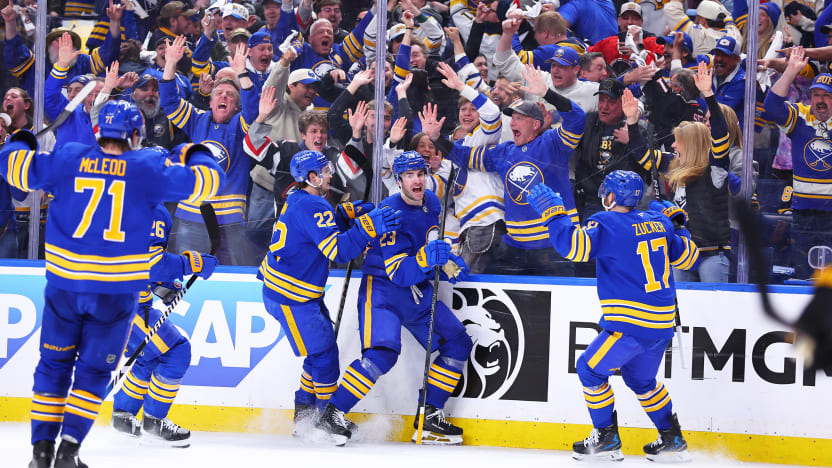
Wednesday night second-round playoff hockey at KeyBank Center with the Buffalo Sabres hosting the Montreal Canadiens in Game 1 of the East second round. Two division-rival clubs that climbed out of the first round and now have to figure each other out in a 60-minute opener. The total is sitting at 6.5 with -165 to the under, and the recreational room is split between the rivalry tradition pushing toward the over and the playoff-defense reality pushing toward the under. The closing market is reading the second-round opener the way the second-round openers usually go: tight, structured, low-event hockey while two coaches feel each other out across 60 minutes. Buffalo's playoff defense has tightened across the first round, Montreal's road structure has held through the road games of round one, the goalie matchup tilts the save-percentage math toward the under, and Game 1 of any second-round series tends to play below the regular-season pace those same teams produced. Three independent inputs all push the same direction, and the closing juice at -165 is gettable on the long side of the under math. The pick is Sabres/Canadiens Under 6.5 at -165 for 3 units.
Pick of the Day
Game 1 Of The Second Round Is Always A Tightening Game
The pattern across years of NHL playoff data is consistent. Game 1 of any second round series, between two clubs that have just finished demanding first-round series, plays below the regular-season pace those teams produced earlier in the year. The reasons are structural. Both clubs are coming off close-out-game adrenaline and a short-rest layoff before the second round opens. Both head coaches are spending the first 30 minutes of Game 1 figuring out matchups, watching how the opposing power play deploys, and pulling in the leash on aggressive forechecking until the line-pairing math settles. The result is a game where the run of play tilts conservative, the special teams get more cautious, and the run-of-play shot quality lands below the regular-season baseline. The total drops accordingly across the historical sample.
The Sabres-Canadiens version of that pattern carries the rivalry context but does not carry an offensive-explosion archetype. Both teams climbed out of the first round on the strength of structured five-on-five defensive shape, not on offensive firepower. Buffalo's run through round one leaned on the checking-line discipline and a goaltending performance at the back end. Montreal's run through round one leaned on the same kind of structural defensive shape with the visiting club holding leads at a high rate in the first round road games. The matchup itself is two checking-line clubs squaring off, not two run-and-gun offenses trading chances. Game 1 of that profile is the textbook under spot.
Buffalo's Defense Has Tightened Through The Playoff Run
The Sabres' regular-season run featured a higher-event five-on-five profile than the playoff version they have been showing across the first round. The transition to the post-season has shifted the Sabres' defensive structure toward a tighter neutral-zone trap, more conservative defenseman pinches, and a longer leash for the checking-line trio that has been deployed against the opposing top six. The save-percentage trend on the Buffalo goaltender has held above his regular-season aggregate, and the goal-against per game across the first-round series tracked below the regular-season number by close to a goal per game. That kind of structural tightening from regular season into playoffs is the standard pattern for any club that advances to the second round, and Buffalo's version of it has been particularly clean.
The Sabres' offensive side has been more matchup-driven than firepower-driven across the first round. The top-six trio has produced when the matchup has been favorable but has not generated multi-goal outputs against structured defensive shape. The bottom six has done the heavy lifting on the forecheck, forcing turnovers and producing low-leverage second-chance shots that translate to one-goal-or-fewer outputs against playoff-shape defense. Game 1 against Montreal lines up exactly the same way. The Sabres' offensive profile against a Montreal road structure is a one-or-two-goals output, which on a 6.5 total puts the math directly in the under leverage band.
Montreal's Road Structure Held Through The First Round
The Canadiens advanced to the second round on the back of a road defensive structure that punched above the regular-season weight. The road games of round one featured Montreal in lead-protect mode for stretches the regular season did not produce, and the goaltender on the road carried a save percentage well above his season aggregate. The Canadiens' approach in road games is a 1-3-1 neutral-zone shape that compresses the run of play to the perimeter, removes high-danger chances, and forces the home offense to win the special teams battle to crack the run-of-play scoring. Buffalo's power play has been workable but not lethal, and the Sabres' goal differential at home has been driven more by five-on-five forechecking than by structured power-play conversions.
The Canadiens' offensive ceiling on the road has lagged the home version by close to a goal per game across the regular season, and the playoff sample is consistent with the regular-season shape. Cole Caufield is the high-event forward whose ceiling can change a game on a single power-play look, but his regular-season road production has lagged his home production by a meaningful margin, and the playoff trend has held the same shape. Nick Suzuki's two-way profile travels better, but the Suzuki line on the road is not the offensive engine that produces three-goal outputs against playoff-shape defense. The road Canadiens against the home Sabres is a two-goals-or-fewer projection, which on a 6.5 total holds the under math.
The Goaltending Matchup Tilts The Save-Percentage Math
The save-percentage math on a 6.5 total in a Game 1 spot is the part the closing line at -165 has not fully credited. Both goaltenders have run save percentages above their regular-season aggregates across the first round. The Buffalo goaltender's first-round save percentage tracked north of .920, and the Montreal goaltender's first-round save percentage tracked in the same zone. Two goaltenders performing at .920-or-better against playoff-shape shot volume produce expected goals against per 60 minutes that compresses to the 2.4 to 2.7 zone. Two times that number is 4.8 to 5.4 expected goals across 60 minutes, which falls cleanly inside the under-6.5 leverage band.
The structural impact for the under ticket is that the goaltending matchup is not random variance. It is two goaltenders who have lifted their save percentages into the playoff sample and are trending consistent across the first-round work. The closing market line at -165 has built some of the goalie-form input into the total, but not all of it. The under ticket is paying for the residual gap between the closing-line implied total and the actual goalie-and-defense-adjusted expected total.
The Risks Worth Naming
A 4-3 or 5-3 game blows the under, and Game 1 of the second round can produce that result. The model assigns a 4-or-more-goals-on-one-side scenario roughly 22 percent probability based on the sample of historical Game 1 second-round outputs. A power-play feast on either side, where one team converts two or three power-play opportunities into goals, can clear the 6.5 line on its own. The model lands this scenario at roughly 16 percent. Empty-net goals in the final minutes can push a game from 5-2 to 6-2 and land it on or above the line, depending on the closing minutes. The model accounts for empty-net variance at roughly 8 percent.
The bet is not that those scenarios cannot happen. The bet is that the cumulative under probability sits in the 60 to 65 percent zone against the closing implied 62.3 percent at -165, with the structural tightening of Game 1 second-round play, the goaltending matchup, and the two-team road-and-home defensive structures all pushing the same direction. The math justifies the 3-unit stake at -165.
The Bottom Line
Wednesday at KeyBank Center with the Sabres hosting the Canadiens in Game 1 of the second round. Two division-rival clubs that climbed out of the first round on structured defensive play, two goaltenders trending above their regular-season save percentages, and a Game 1 second-round profile that historically tightens the run of play below the regular-season pace. The closing line at 6.5 with -165 to the under has not fully credited the second-round opener pattern, the goalie-form math, or the road-and-home defensive structures both clubs bring into the series. The under at -165 holds the value, the math justifies the 3-unit stake, and the bet is the cleanest second-round opener spot on the May 6 board.
Buffalo Sabres (Home)
- Series: Second round Game 1
- First-round result: Advanced
- Playoff defense: Tightened structure
- Top-six driver: Tage Thompson
- Defense anchor: Rasmus Dahlin
- Venue: KeyBank Center
Montreal Canadiens (Road)
- Series: Second round Game 1
- First-round result: Advanced
- Road structure: 1-3-1 neutral-zone trap
- Top-six driver: Nick Suzuki, Cole Caufield
- Goalie form: Above regular-season aggregate
- Approach: Lead-protect on the road
The Bet
- Side: Under 6.5
- Price: -165
- Implied: 62.3%
- Model: 65 to 68%
- Stake: 3 Units
- First puck: 7:00 PM ET
For more BetLegend free picks across the NHL Stanley Cup Playoffs, MLB regular season, NBA Playoffs, and college sports, browse the homepage or check our full track record.