
Marquee Matchup
MLBN

Dodgers vs White Sox

Friday, 7:40 PM ET | Rate Field, Chicago

The best team in the National League rolls into the South Side, and the Dodgers arrive at 44-25 with a plus-143 run differential that is the largest in all of baseball. Los Angeles has been a juggernaut on both sides of the ball, and a road trip to face a 36-31 White Sox club is exactly the kind of spot where the talent gap shows up over nine innings even if the records are not a mile apart. Chicago has actually been respectable at home and sits above .500, but they are giving up real ground in run differential at plus-10, and the margins against a Dodgers lineup this deep are unforgiving.

The pitching matchup is the storyline. Los Angeles sends Roki Sasaki, who carries a 4.03 ERA and a 1.26 WHIP across 58 innings with 60 strikeouts and a 9.31 K/9. Sasaki has the swing-and-miss arsenal to carve up a White Sox lineup hitting .242 as a team, and when he commands his splitter he can make even a power-capable lineup look overmatched. The Dodgers will want length out of him to protect a bullpen that carries a heavy postseason-caliber workload across a long season.

Chicago counters with Anthony Kay, a 5-1 left-hander whose record flatters a 4.40 ERA and a 1.45 WHIP. Kay has been putting runners on at a high rate all season, and against a Dodgers lineup that punishes traffic, the danger is obvious. The White Sox path is to keep Sasaki's pitch count climbing, work deep counts, and hope Kay can navigate five competitive innings before turning it over. For Los Angeles, this is about doing to a middling opponent what the best team in the league is supposed to do.


Pitching Spotlight
Local

Cubs vs Giants

Friday, 10:15 PM ET | Oracle Park, San Francisco

Two evenly matched-on-paper clubs meet by the bay, with the Cubs at 35-34 and a plus-4 run differential against a Giants side sitting at 28-41 with a minus-51 differential that says San Francisco has been the more disappointing team this season. Oracle Park is one of the more pitcher-friendly venues in the sport, which only sharpens the focus on the arms in a game where runs may be at a premium under the marine layer.

San Francisco leans on Landen Roupp, who has quietly become their most dependable bat-misser. Roupp carries a 4.00 ERA across 69.2 innings and 13 starts, but the eye-catching number is 77 strikeouts and a 9.95 K/9, the kind of swing-and-miss profile that plays up in a big ballpark. The Giants offense has scored just 4.19 runs per game, so they need Roupp to keep the game tight and trust the spacious dimensions to hold down a Cubs lineup that strikes out at a healthy clip.

Chicago answers with Javier Assad, who is working back toward a full workload after a limited start to the year. Assad owns a 4.73 ERA, a 5.29 K/9, and only 32.1 innings across three starts, so his ability to miss bats lags well behind Roupp's. The Cubs lineup, at 4.59 runs per game, is the slightly more productive group on the season, but in a park that suppresses offense and against a pitcher generating whiffs, every baserunner is precious. This is a classic low-event, pitching-led matchup where the team that strings together a rare clean inning likely takes it.

Strikeout Showcase
Local

Braves vs Mets

Friday, 7:15 PM ET | Citi Field, New York

This is the best pure pitching matchup on the board. The Braves bring the best record in the breakdown at 45-23 with a plus-114 run differential, and they hand the ball to Spencer Strider, who pairs a 4.00 ERA with a ferocious 10.75 K/9 and 43 strikeouts across 36 innings. Strider's fastball-slider combination is built to overwhelm, and a Mets lineup hitting just .228 with a .658 OPS, the weakest offense in this entire group, is a difficult night waiting to happen for New York's hitters.

The Mets, at 30-38, counter with Nolan McLean, who has been one of the quiet stories of their season. McLean carries a 3.98 ERA, an 82-strikeout total across 72.1 innings, and a 10.20 K/9 of his own, so this is a genuine duel of two arms missing bats north of a strikeout per inning. Citi Field is a fair-to-pitcher-friendly environment, and when both starters are punching out hitters at this rate, the rallies have to be earned the hard way.

The contrast in the lineups is what gives the game its shape. Atlanta is scoring 5.15 runs per game and is clearly the more dangerous offense, which puts the pressure on McLean to keep the Braves' power in the park. New York's bats, meanwhile, have been a season-long struggle, and against Strider's swing-and-miss, the Mets may have to manufacture runs through patience and timely contact rather than slug their way back into anything. Two double-digit-K/9 starters in a pitcher's park is the textbook recipe for a tense, low-scoring night.

Arm To Watch
Local

Mariners vs Nationals

Friday, 6:45 PM ET | Nationals Park, Washington

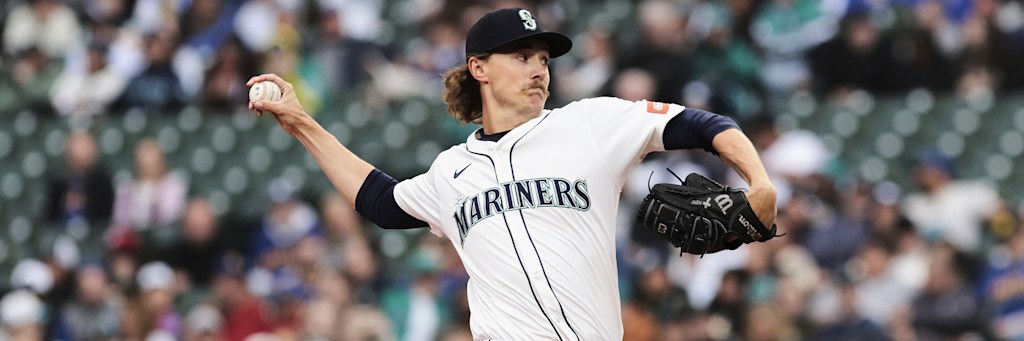
Seattle travels to Washington with the best pitching staff in this breakdown, a 3.59 team ERA and a 1.20 WHIP, and they send out the arm that has been the talk of their rotation. Bryce Miller has been close to untouchable since returning, posting a 1.33 ERA and a remarkable 0.78 WHIP across four starts and 27 innings with 29 strikeouts. A WHIP that low means Miller is barely allowing a baserunner per inning, and that is the kind of profile that can quiet even a productive lineup.

And the Nationals are productive. Washington is actually scoring 5.39 runs per game, the highest figure of any team featured here, with 372 runs already on the board and a .742 team OPS. At 35-34 with a plus-7 differential, they are a roughly average club, but their bats have been a genuine strength, which makes the Miller matchup compelling: a suffocating arm against a lineup that has hit all season. Something has to give.

Washington counters with Zack Littell, who carries a 4.76 ERA and a 1.31 WHIP across nine starts. That is a clear rotation gap on paper, and it puts the onus on the Nationals offense to get to Miller early before the Mariners bullpen can lock things down. For Seattle, the blueprint is simple: let Miller keep the bases empty, lean on a top-tier run-prevention staff, and trust that a 4.24-runs-per-game offense can scratch across enough. It is a matchup of strength on strength, Seattle's arms against Washington's bats, and those are usually the most watchable games on any board.